Creative
Why Your Creator Ads Start to Look the Same
Creators should be your best source of new concepts. Here's why most creator programs end up making variations instead, and how to set them up differently.
If you're spending $250K+ a month on Meta, making ads probably isn't the hard part. Your team can do that. The hard part is having enough new ideas to test before your best ads wear out.
Creators should help with that. Each one comes to your product from their own life and talks to an audience you don't have. But most creator programs are set up in a way that flattens those differences, and a few months in, the creator ads start to look a lot like each other.
Variations and concepts
Most accounts have far fewer real ideas in them than ads. Fifty ads can easily come from five ideas.
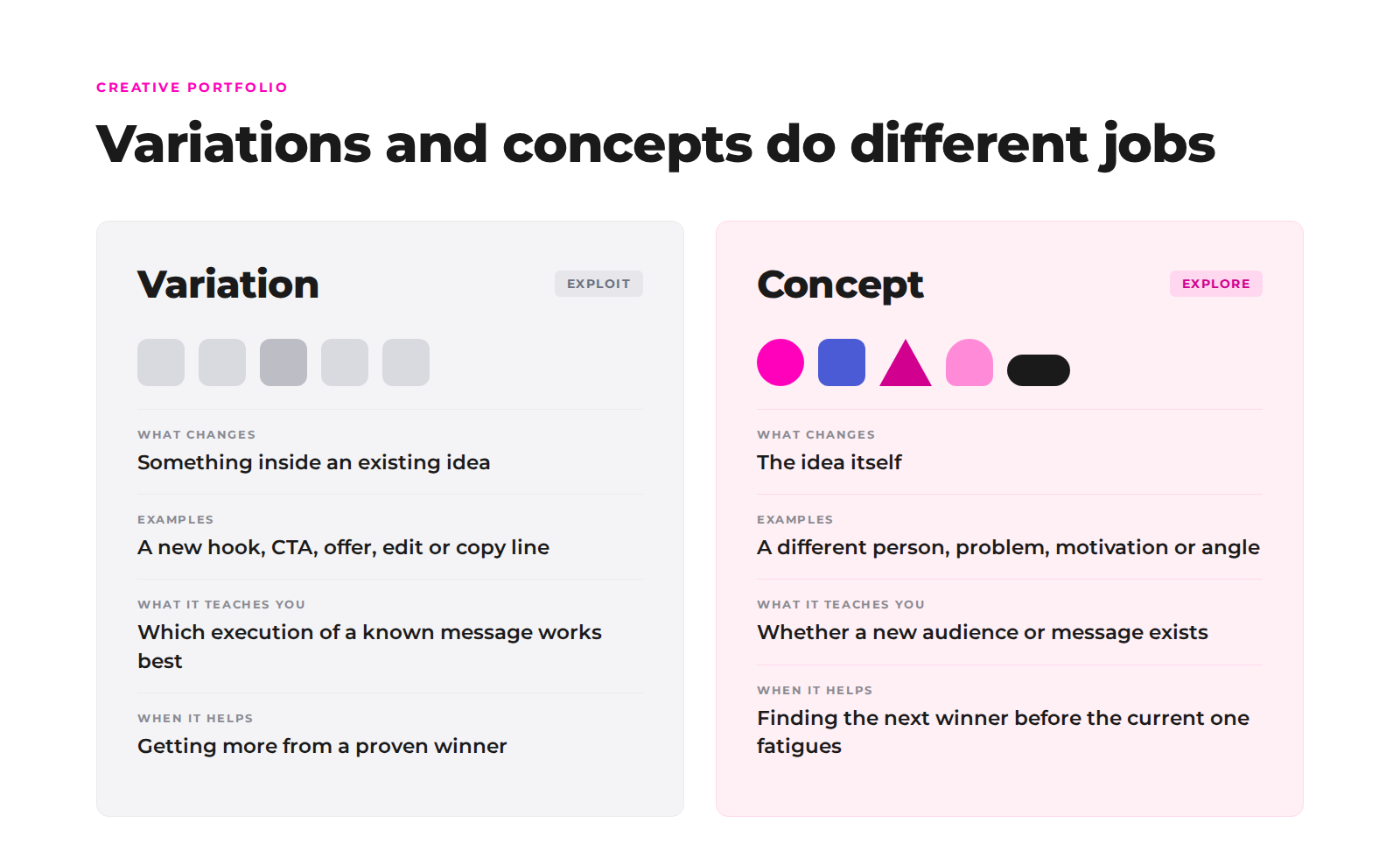
Variation
- What changes: Something inside an existing idea
- Examples: A new hook, CTA, offer, edit or copy line
- What it teaches you: Which execution of a known message works best
- When it helps: Getting more mileage from a proven winner (exploit)
Concept
- What changes: The idea itself
- Examples: A different person, problem, motivation or angle
- What it teaches you: Whether a new audience or message exists
- When it helps: Finding the next winner before the current one fatigues (explore)
You need both. Variations get more out of a winner, and concepts find the next one. Variations are just much easier to make, so they tend to take over.
What Meta is rewarding now
Meta's ad system now leans on the creative to work out who should see an ad. In March 2025, Meta said that as AI-driven ad tools spread, creative diversification had overtaken niche targeting as the best way to find the right audiences (via Jon Loomer).
A lot of that happens in Andromeda, the retrieval system Meta announced in December 2024. Retrieval is the first cut. It takes tens of millions of eligible ads and picks a few thousand for each person, and only those go on to ranking. Meta says Andromeda runs models with 10,000x the capacity of the old system, and that it improved retrieval recall by 6% and ads quality by 8% on selected segments (Meta Engineering).
Similar ads don't get much out of this. In September 2026, Marketing Brew reported that Meta has been telling agencies that ads sharing a look or an opening hook with an advertiser's other creative won't rank as highly, because the system treats them as the same ad. Meta's spokesperson called creative diversity a longstanding best practice (Marketing Brew).
So at $250K+ a month, the number worth watching is how many distinct ideas you have live, more than how many ads.
Where creators come in
A new concept needs a new person or a new way into the story. Creators bring both before you've written the brief. Most aren't media buyers or editors, and they don't need to be. What they're good at is reacting to a product honestly and telling the story in a way the brand couldn't write for itself.
We saw this at a roundtable we hosted recently with Janet, a wellness and lifestyle creator with around 70k Instagram followers, and a group of brand marketers.
Janet walked us through two Reels she made for a health brand's new telehealth product. The brand asked for a story, not a list of features. The idea was hers: a tongue-in-cheek narrator trend going around Instagram at the time. In the first Reel, the narrator introduced her as "a health and wellness girl" whose usual routines had stopped working. In the second, she dropped the narrator and talked to camera about how the product helped. The two Reels reached about 475,000 people.
Nobody on the brand side came up with that. It came from Janet knowing what her audience would actually watch.
She also said briefs have opened up a lot over the past few years. Most now give her the product facts and brand pillars, then ask her to do it in her own voice. That kind of brief is what leaves room for a new idea.
How creator programs drift back to variations
Most programs start out with the right idea. A few habits pull them back.
- The same script for everyone. If every creator reads the same talking points in the same order, you've made one ad with a lot of different faces.
- Counting videos. Forty creator videos built on one angle add very little to the account.
- Picking creators for reach. Some brands treat creators as a way into someone else's audience. Janet's advice was to start with people who already use the product and post about it. Once you have the right person, paid media can take care of reach.
- One-off partnerships. Every new creator starts from nothing. Janet prefers longer partnerships, some running a year at one video a month, because the story gets deeper. A creator who knows the brand well keeps finding new angles on it.
- Leaving creators to edit. After years of podcasting, Janet is comfortable on camera. Editing was the part she found hardest. Every hour a creator spends editing is an hour they're not spending on the idea.
Setting up creators to produce concepts
This is mostly a process change, and it works with the creators you already have.
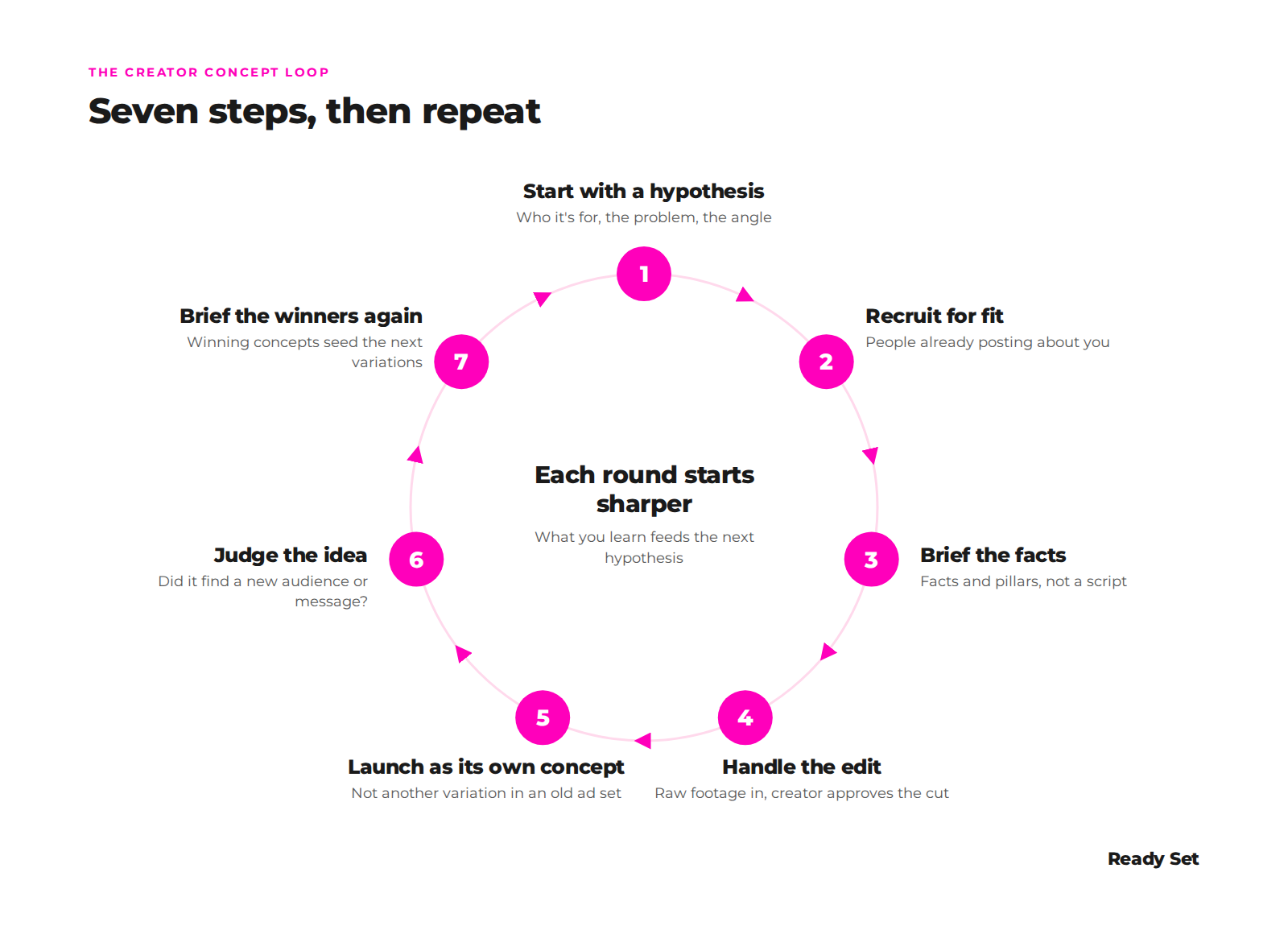
- Start with a hypothesis. Write down who the concept is for, the problem it speaks to and the angle it takes. Note whether it's a new bet (explore) or a new take on a proven winner (exploit).
- Recruit for that hypothesis. Start with people already posting about you. Decide early whether a creator is there for reach or depth: high-reach creators suit awareness, and creators with engaged audiences suit detail and conversion.
- Brief the facts. Share the product facts, brand pillars and compliance limits, then leave the execution to the creator. If you like one of their past videos, point to it.
- Handle the edit. Ask for raw footage, edit and check compliance on your side, and let the creator approve the final cut. In regulated categories, this also stops compliance changes from bouncing back and forth.
- Launch it as its own concept. Run creator content as a distinct idea in the account, often from the creator's own handle, rather than dropping it into an existing ad set as another variation.
- Judge the idea. Ask whether it found a new audience or message worth scaling. That tells you more than which cut won.
- Brief the winners again. Go back to the creators whose concepts worked, with what you learned. Their winning concepts become the starting point for your next round of variations.
What to measure
Reach and views still matter, but they won't tell you whether your creators are adding anything new to the account. These will:
- Distinct creator concepts in market: how many different ideas the program is producing, not how many videos
- Concept win rate: how often a new creator concept beats your current best ad
- Spend concentration: whether one creator, theme or ad is carrying too much of the account
- Footage-to-launch time: how quickly a creator's idea gets into market and starts producing a signal
- Repeat creator share: how much of the program comes from creators you've worked with before
Agree on the business metric before the first brief goes out. Over the past few months, our team has heard brands at creator events move from asking about reach to asking how a creator program tracks back to sales. It's much easier to answer that if tracking is in the plan from the start.
A more useful question
Almost every brand at this spend level is using creators. The more useful thing to ask is how many new concepts your creator program put into market this quarter, and how many of them became a winner.
If that number is low, look at the brief, the workflow and how the content gets launched before you start replacing creators.
That's most of what we do at Ready Set: deciding which ideas are worth betting on, then getting creator work live quickly enough to learn from it.
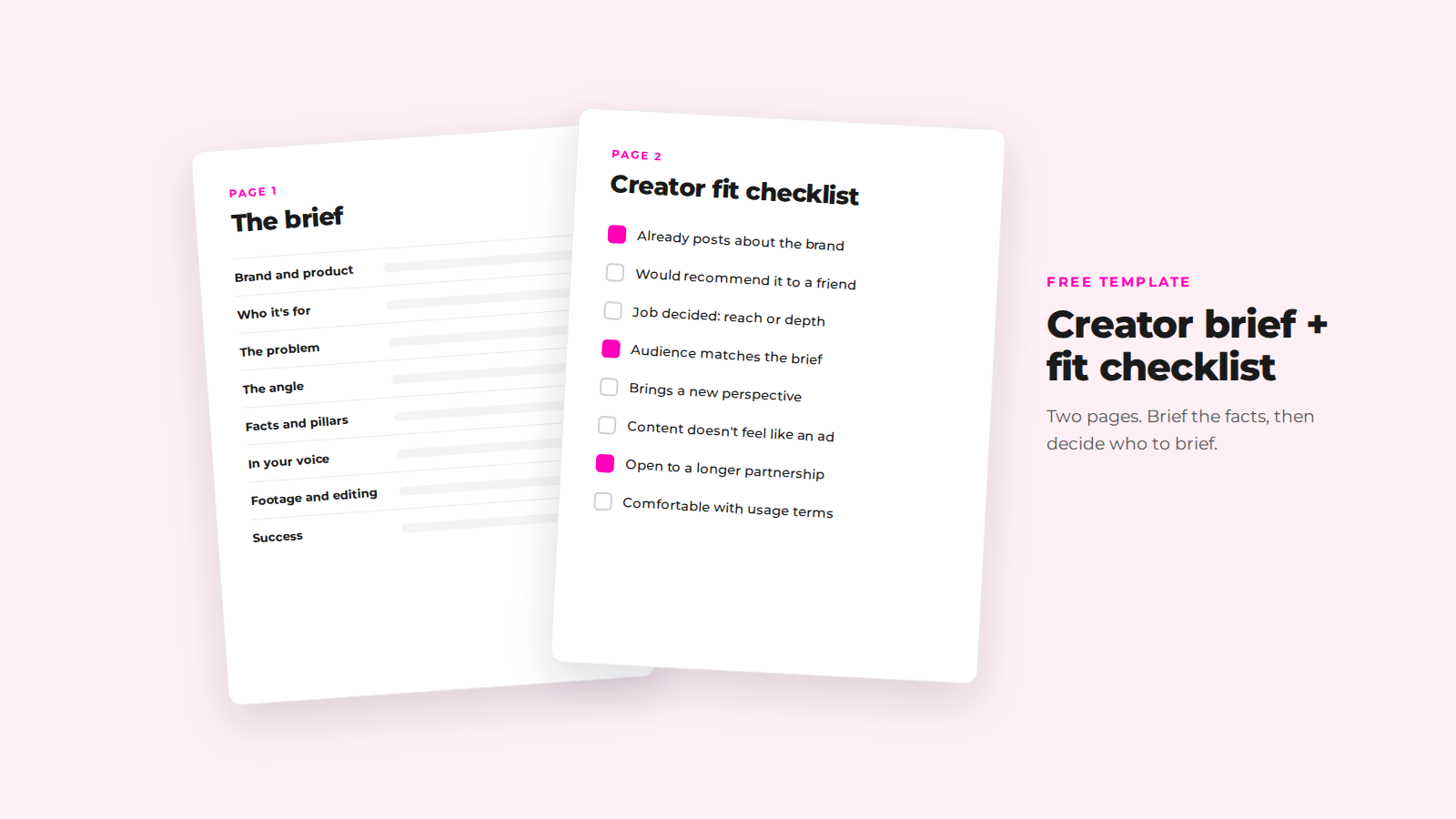
We turned what we learned from the roundtable into a creator brief template with a fit checklist.
Keep reading
More articles.
Get the good stuff in your inbox.
New articles from the Ready Set team, sent when they're published.