Strategy
How to Capitalize on Q5 While Your Competitors are Sleeping Through It
Why the weeks after Christmas are one of the most underpriced windows in performance marketing, and how to build creative for them.
New Year's traditions are all over the map. In Spain, you eat 12 grapes, one for each stroke of midnight. In Japan, you slurp soba noodles for longevity. Greeks hang onions on their doors. Scots carry coal to neighbors. Brazilians jump seven waves in the ocean. But strip away the specifics and you're left with the same core psychology: out with the old, in with the new. And in about a month, that mindset shift creates one of the most underpriced windows in performance marketing.
Here’s what’s inside:
- The Omnicom shakeup and what it really signals
- Why Q5 is the most overlooked growth arbitrage of the year
- The “Treat Yourself” ad that nails January psychology
The Brief 💼
What happened this week in DTC performance marketing.
Omnicom completes $13B IPG acquisition—and the fallout is already massive.
4,000 jobs cut, iconic agencies DDB, FCB, and MullenLowe shuttered, and the entire org reorganized around Omni, an AI-powered data platform.
(Side note: DDB won Cannes network of the year this year—now it's being axed.)
Omnicom have shown their hand: they're betting on efficiency over creativity.
Here's the tension: Meta's Andromeda update positioned creative as the primary performance lever. Omnicom is optimizing for efficiency at the exact moment ad platforms are optimizing for variety.
To be fair, not every channel rewards variety the way Meta does—yet. But the algorithmic ad model is expanding across platforms. And for brands whose growth runs through paid social, the tension is already real.
Holding companies are optimizing for efficiency. Platforms are optimizing for creativity. The brands that survive this shift will be the ones who know how to do both—without losing their soul.
Will AI end buyer/seller information asymmetry?
A recent article in The Economist makes a compelling case.
The TL;DR: when everyone has a "genius in their pockets," consumers become savvier and harder to mislead. There's a deeper lesson here for creative strategists…
Your audience is doing more homework than ever before.
We've seen this with our client, Happy Head. Speaking to people as if already knowledgeable about hair loss treatments (e.g. minoxidil vs. finasteride) led to better performance.
The takeaway isn't that consumers are suddenly geniuses. It's that access to expertise—at least a reasonable facsimile of it—is being rapidly democratized. Creative that talks down to buyers is increasingly likely to get scrolled past by people who've already ChatGPT'd their way to informed.
Performance Marketing Strategy
Most performance marketers treat the weeks after Christmas like the off-season. Budgets get slashed. Creative teams take a breather. Media buyers nurse their Q4 burnout.
But in reality, this "dead zone" is actually one of the most mispriced, psychologically unique periods in the entire performance calendar—and a window of opportunity for savvy marketers.
Welcome to Q5.
The Hidden Arbitrage Most Marketers Miss
Most brands shut off spend after Christmas, creating an auction environment you almost never see during the rest of the year.
When competitors leave, three things happen:
- Ad costs collapse. Varos data shows that Meta CPMs dropped 23% from December to January last year. TikTok fell 27.5%. Google dropped 14%.
- Auction pressure evaporates. Fewer advertisers means less bidding, less creative saturation, cleaner delivery, and more stable learning phases. You're suddenly not fighting 15 promo-heavy brands for the same lookalike audience.
- Engagement stays high, even increases. While CPMs fall, digital attention does not. Holiday downtime equals more hours on devices. New devices gifted means new installs and higher usage. In fact, during the week after Christmas, TikTok views jumped 24% vs. the Q4 average.
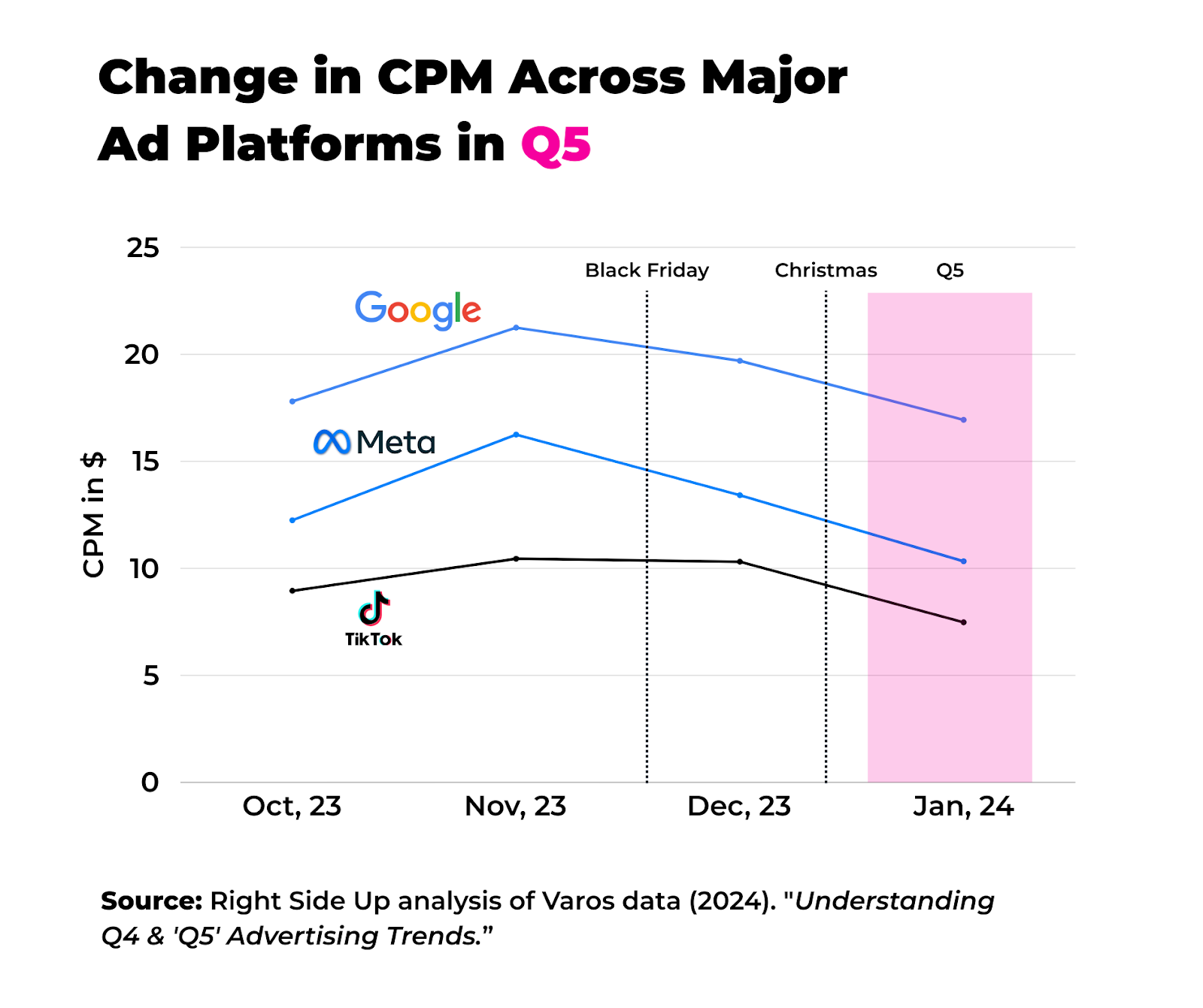
So you get a rare combo: high engagement at low cost. This is why Q5 is one of the most efficient customer acquisition windows of the entire year.
And the story gets even stronger when you look at the psychology behind it.
The Psychology Flip: From Gifting Logic to Identity Logic
For six weeks, consumers buy for others. Then on December 26, the frame flips: "What do I want? Who do I want to be next year?"
So shopping intent doesn't disappear post-holidays, it shifts inward. 92% of customers intend to keep shopping into Q5 but the difference is, 57% of Q5 purchases are self-gifts.
This is where Q5 gets powerful: Consumers move from transactional urgency to transformational identity.
This maps perfectly to categories like fitness, wellness, beauty, personal finance, education, and self-care. If you're selling transformation or self-investment, Q5 is your Black Friday.
The problem is, very few brands adapt their creative to match that shift.
Why Most Creative Breaks in Q5
Most brands reuse their December creative into January because it's easier. The campaigns are built, the learning phase is complete, the data looks good.
But December data doesn’t tell you anything about January psychology.
The mistake is treating Q5 like Q4 with lower CPMs. The entire emotional landscape has shifted. December is externally focused, deadline-driven, and transactional. January is internally focused, possibility-driven, and transformational.
Here's what works:
Brands that win Q5 rebuild their messaging around identity. Instead of "Save 30% on our wellness program," try "Meet the version of yourself who shows up every day." The latter speaks to identity. The former speaks to transaction.
The sequencing matters:
- Dec 26–31 is bridge mode—gift card redemption, post-holiday upgrades, "you deserve this" energy.
- Jan 1–15 is peak Q5—before/after storytelling, testimonials focused on life change, aspirational messaging about the future self.
- Jan 15+ is commitment mode—stick-with-it messaging, routine and discipline angles, supportive tone as New Year's energy fades.
This requires new creative ready to launch on December 26. Not January 2.
Most brands can't move that fast. The brands that dominate Q5 pre-produce variants in early December and treat it as its own campaign phase, not a discounted extension of Q4.
And that brings us to what Q5 really tests.
Q5 Is a Stress Test for Your Performance Marketing Strategy
Brands that lose Q5 aren't losing on media tactics, they're losing on internal velocity.
The brands who thrive operate like a modern media company: fast signals, fast takes, fast iterations, fast creative. And when they carry that momentum into Q1? Meta reports they see 28% higher retention than brands who go dark and restart in mid-January.
Q5 isn't a hack. It's a competitive edge disguised as holiday downtime.
Ad of the Week ✨
If Q5 is the season of self-investment, this ad is the blueprint.
We’re revisiting one of Ready Set’s most effective concepts of 2024: “Treat Yourself” from Wild Alaskan Company — a spot that didn’t just perform, it reshaped how we think about self-care in creative.

- Brand: Wild Alaskan Company
- Length: 26 seconds
- Platform: Meta
Why It Works 🧠
🍽️ It taps directly into self-investment. The ad tells viewers that choosing high-quality food is self-care, a perfect match for Q5’s “better me” mindset.
🎧 It elevates a commodity into an identity choice. Instead of “buy fish,” it tells the viewer: you deserve premium-quality food. Fish isn’t just dinner. It becomes a lifestyle upgrade.
🧩 It uses familiar language to unlock a new audience. “Treat yourself” is instantly recognizable and culturally loaded, making it easier to resonate with viewers who don’t think of seafood as indulgence.
Creativity isn’t always about inventing something new — often it’s about combining two familiar ideas in a way the audience hasn’t seen before.
Thanks for reading!
That’s all for this week. Seeya next time 🫶
Keep reading
More articles.

Get the good stuff in your inbox.
New articles from the Ready Set team, sent when they're published.